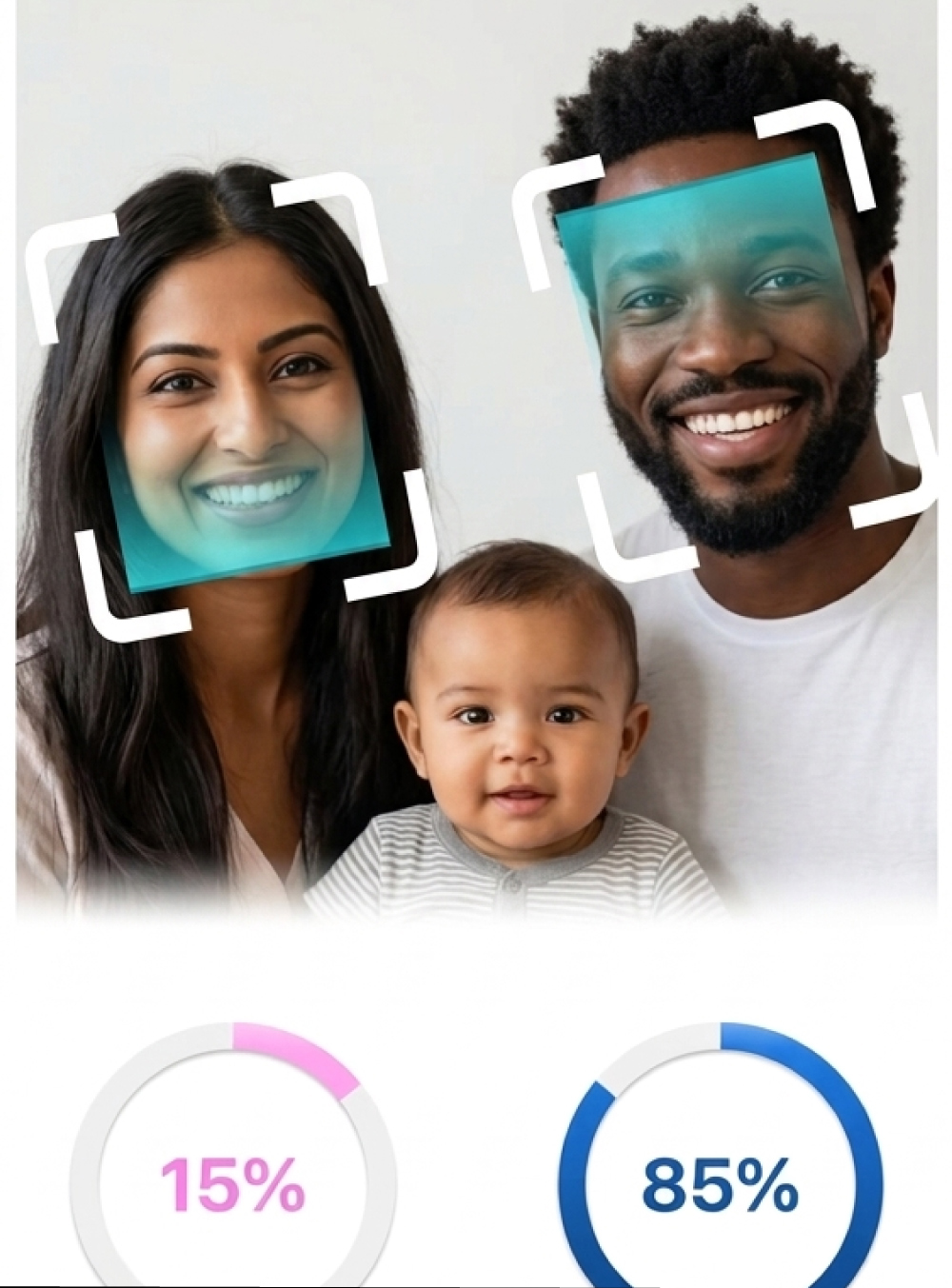
We are excited to announce the launch of Baby Generator — a new app from UpName that brings together advanced visual AI and genetic science to predict what a couple’s future baby might look like. Baby Generator is not a simple face-morph tool. It is a ground-up fusion of image analysis, facial feature extraction, and probabilistic genomic modeling, designed to produce baby predictions that are not only visually compelling but genetically plausible.
Download Baby Generator on Google Play
From Pixels to Phenotypes: How Baby Generator Works
The pipeline begins with advanced visual AI models that perform detailed image analysis on each parent’s photo. The system detects and extracts dozens of key facial features — eye shape and color, nose bridge width and projection, lip fullness, jawline contour, brow arch, cheekbone structure, skin tone, hair color and texture, and many more. Each trait is isolated, quantified, and normalized across varying lighting, angles, and complexions. This is not pixel averaging — it is semantic facial understanding, built on models trained to distinguish the fine-grained anatomical characteristics that define a person’s appearance.
Once the visual AI has extracted the feature set from both parents, the real innovation begins. Rather than blending these features equally — the way a simple morph tool would — Baby Generator feeds the detections into a probabilistic table modeled on offspring genomic probability. Each trait is evaluated against known patterns of genetic inheritance to determine how it is likely to express in a child.
Genomic Probability: Predicting Inheritance Trait by Trait
Consider eye color. A mother with blue eyes and a father with green eyes do not simply produce a child with an eye color halfway between the two. In reality, eye color inheritance follows complex probabilistic rules governed by multiple genes. The system models the likelihood of the child inheriting a specific eye hue based on the known dominance relationships and allele combinations of the parents. Blue eyes are generally recessive, green eyes involve a different set of allele interactions, and the resulting probability distribution for the child’s eye color reflects these genetic realities — not a naive average.
This same probabilistic approach is applied across every detectable facial trait. Lip shape, nose width, hair color, skin pigmentation, earlobe attachment, dimples, cleft chin — each is run through its own inheritance model, producing a genetically weighted prediction rather than a visual blend.
The Challenge of Polygenic Inheritance
One of the most formidable challenges in offspring prediction is polygenic inheritance — the reality that many facial traits are not controlled by a single gene but are influenced by lots and lots of different genes acting together. Skin color, for example, is governed by at least a dozen genes, each contributing incrementally to the final pigmentation. Facial proportions, nose shape, and jawline structure are similarly polygenic, making their inheritance patterns far more complex than simple Mendelian dominant-recessive models can capture.
Baby Generator’s probabilistic engine is built to handle this complexity. Rather than reducing each trait to a single-gene model, the system accounts for the cumulative, additive effects of multiple genes. The result is a prediction that captures the continuous spectrum of variation seen in real human populations — not a binary coin flip between one parent’s trait and the other’s.
Incomplete Dominance: When Traits Blend
Classical genetics teaches dominant and recessive inheritance, but many traits do not follow this clean binary. Incomplete dominance occurs when neither allele is fully dominant, and both genes blend together to produce an intermediate phenotype. A parent with very full lips and a parent with thin lips may produce a child with moderately full lips — not because the AI is averaging pixels, but because the genetic model predicts an intermediate expression. Hair waviness, skin tone gradients, and nose bridge height are other examples where incomplete dominance produces outcomes that fall between the two parental phenotypes.
By incorporating incomplete dominance into the prediction pipeline alongside classical dominance, recessiveness, and polygenic effects, Baby Generator produces offspring faces that reflect the full richness of real genetic inheritance — not a simplistic either/or selection from each parent.
Recent Advances in Genomic Research
The timing of Baby Generator’s launch is no accident. Recent advances in genomic research have dramatically improved our understanding of how facial traits are inherited. Large-scale genome-wide association studies (GWAS) have identified hundreds of genetic loci associated with facial morphology, eye color, hair characteristics, and skin pigmentation. These studies — spanning diverse populations and hundreds of thousands of participants — have produced far more precise probability tables for trait inheritance than were available even a few years ago.
Baby Generator incorporates these latest findings directly into its prediction models. The probabilistic tables that drive offspring trait prediction are informed by current genomic research, making the system’s outputs more accurate and more representative of real-world genetic diversity than any previous approach. As genomic science continues to advance, the app’s models are designed to evolve alongside it.
From Analysis to Synthesis: Building a Coherent Face
Predicting individual traits is only half the challenge. The system must then compose dozens of independently predicted features — each with its own probabilistic weighting — into a single face that looks natural and coherent. Eye spacing must be proportional to nose width, skin tone must be consistent across all features, and the overall facial geometry must follow realistic human anatomy. Baby Generator’s generative models enforce this global coherence through multiple refinement passes, producing studio-quality results that look like real children, not digital composites.
Available Now
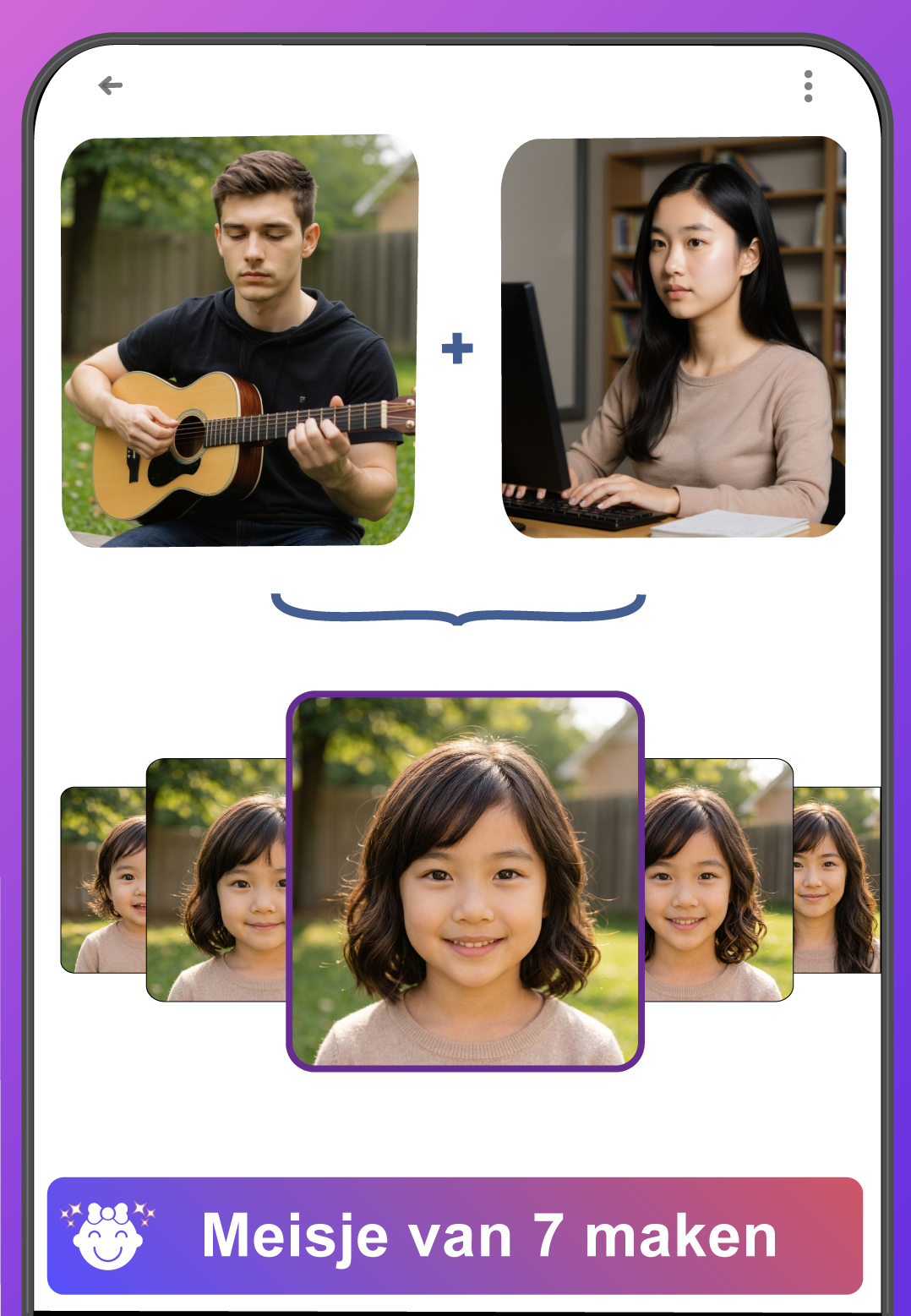
Baby Generator is available today on Google Play. Upload two parent photos, choose your baby’s age and gender, and let the AI — powered by real genetic science — show you what your future child might look like. Learn more on the Baby Generator app page.